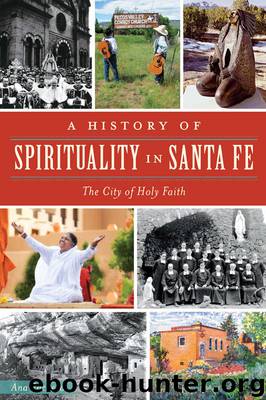
A History of Spirituality in Santa Fe: The City of Holy Faith by Pacheco Ana
Author:Pacheco, Ana [Pacheco, Ana]
Language: eng
Format: epub
Publisher: Arcadia Publishing Inc.
Published: 2016-02-22T05:00:00+00:00
The meetinghouse of the Society of Friends on Canyon Road. Photo by Ana Pacheco .
Members at a service of the Society of Friends on Canyon Road. Courtesy the Society of Friends .
The Unitarian Universalism congregation in Santa Fe was formed in 1952 when a group of religious liberals from Santa Fe and Los Alamos held their first meeting at the La Fonda Hotel. A representative from the American Unitarian Association in Boston was brought in to advise the group on the steps necessary to form the Santa Fe Fellowship. For the next several years, the group met in rented offices, and in 1968, the members purchased and renovated an old house that became their first church. Ten years later, as their membership grew, they purchased the Mormon Church on Barcelona Street. Since then, they have remodeled and expanded the church.
Unitarian Universalism has an open-minded theology that incorporates democratic ideals and the evolution of science. The church is closely related to the Congregational Church (aka the United Church of Christ) that was formed by Protestant Christians who arrived on the Mayflower. Followers of both the Unitarian Universalism tradition and the Congregational–United Church of Christ have been active in the abolition of slavery, environmental education, health reform and many other socially conscious efforts. Above all else, the mandate of both traditions is to share in the journey toward more meaningful lives with all people regardless of religion, race or sexual orientation.
The first recorded work of the Congregational Church (United Church of Christ) in Santa Fe is a letter, dated 1856, that a representative of the “American Missionary Society (AMA)” stationed here wrote to the AMA board in Massachusetts. He wanted their financial support to buy a printing press to produce tracts, simple brochures, for the citizens and U.S. soldiers in northern New Mexico. His focus wasn’t salvation but slavery or, more precisely, its abolition. The AMA, founded by the Congregational Church and other Christian denominations, was the country’s main antislavery organization. Although the Roman Catholic Church had abolished the practice of slavery centuries before, U.S. Protestant churches throughout the South supported the buying and selling of human lives. Congregational Christians offered a different understanding of the Christian faith. The man, whose name is lost to history, had been sent by the Congregational Church to New Mexico to help make sure the newly acquired U.S. territory remained free.
After the Civil War, the Congregational Church, through the AMA, sent both clergy and laypeople to the South to start churches and schools for the newly freed African Americans. Education had always been a part of Congregationalism, back to the founding of Yale and Harvard, because people were not truly free without education. In the 1870s, the AMA also started both a church and a Congregational college in Santa Fe. The first “University of New Mexico,” it was housed in the Victorian-style building that still stands across from the train station. Like Oberlin and other Congregational colleges, the school was coeducational and interracial to serve people often denied access to higher education, including women.
Download
This site does not store any files on its server. We only index and link to content provided by other sites. Please contact the content providers to delete copyright contents if any and email us, we'll remove relevant links or contents immediately.
Shoot Sexy by Ryan Armbrust(17733)
Portrait Mastery in Black & White: Learn the Signature Style of a Legendary Photographer by Tim Kelly(17010)
Adobe Camera Raw For Digital Photographers Only by Rob Sheppard(16984)
Photographically Speaking: A Deeper Look at Creating Stronger Images (Eva Spring's Library) by David duChemin(16691)
Bombshells: Glamour Girls of a Lifetime by Sullivan Steve(14082)
Art Nude Photography Explained: How to Photograph and Understand Great Art Nude Images by Simon Walden(13053)
Perfect Rhythm by Jae(5415)
Pillow Thoughts by Courtney Peppernell(4290)
The Book of Joy by Dalai Lama(3996)
Good by S. Walden(3564)
The Pixar Touch by David A. Price(3445)
A Dictionary of Sociology by Unknown(3089)
Fantastic Beasts: The Crimes of Grindelwald by J. K. Rowling(3063)
Stacked Decks by The Rotenberg Collection(2888)
Humans of New York by Brandon Stanton(2876)
Read This If You Want to Take Great Photographs by Carroll Henry(2714)
On Photography by Susan Sontag(2643)
Insomniac City by Bill Hayes(2561)
Photographic Guide to the Birds of Indonesia by Strange Morten;(2539)
